
Looking Small Is Mostly a Habit
I remember this one moment I shared with an illustrator.
We were sitting in a coffee shop that charged premium prices for existential dread and burnt beans. He leaned in like he was about to confess a crime.
“I think I look small.”
Not I am small. Not paid small. I"Look" small.
Which, if you’ve been in this game long enough, you’ll know fells far worse. At least invoices can be edited.
I asked him what “small” meant.
He paused. The kind of pause where your brain is clearly buffering old LinkedIn comparisons, Behance stalking sessions, and that one creative director who said “we love your work” and then vanished like a ghost with a mood board.
He tried a few definitions.
“Not senior enough.”
Ah yes. Senior. That mythical creature. Usually spotted on agency decks and rarely in the wild.
So we poked at that.
Is “senior” a title? Because I’ve seen people promoted to “Senior Illustrator” after surviving three chaotic clients and a Dropbox folder.
Is it years? Because time served doesn’t always equal taste improved. Sometimes it just means you’ve been tired longer.
Is it clients? Because one big logo can turn a portfolio into a shrine overnight.
He didn’t like any of those answers. Which was promising.
Because it meant we were getting closer to the uncomfortable part.
The part where nothing external could carry the weight of that word.
What we kept circling back to, over and over, was behaviour. It was frustrating how often this happened.
No cinematic moment that changes everything. Just boring, repeatable stuff.
How he spoke about his work. How he defined scope before the client got creative with the definition of “small revision.” How he handled silence after sending a quote. How he priced when the client said, “We don’t have a big budget, but great exposure.”
That last one always shows up like an uninvited cousin.
And here’s where it got interesting.
Because none of those behaviours require permission.
You don’t get a formal go-ahead, you just learn to write clear scopes one word at a time.
You just… start doing it.
At first it's awkward. But so where your first steps.
But repetition does something sneaky.
It builds momentum, new habits collaborate and cancel out old outdated ones over time.
Before you know it the first number that comes out of your mouth when you're asked to quote is the one you truly want. Hold a boundary often enough, and eventually you stop writing apology paragraphs around it.
It stops being performance.
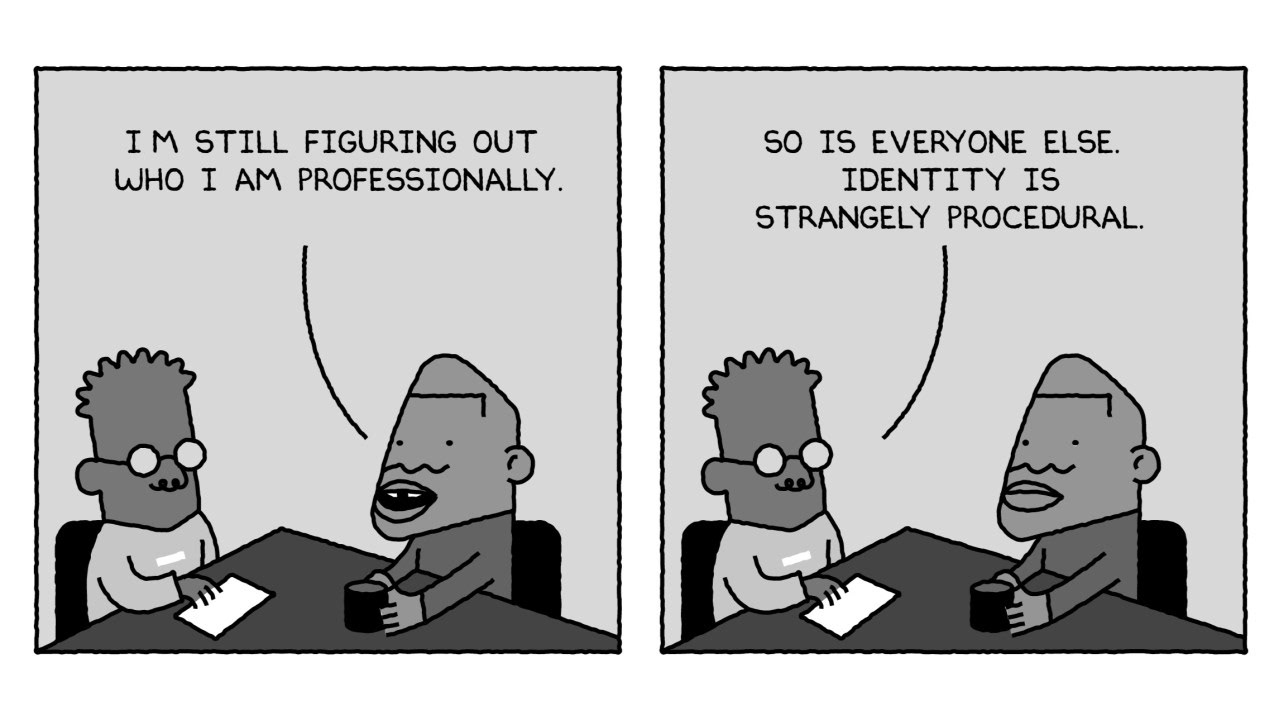
It starts looking like identity.
And clients, who are basically pattern-recognition machines with budgets, pick up on that faster than you think.
They don’t run a checklist titled “Is this person senior?”
They watch how you behave under mild pressure.
Do you fold? Do you explain? Do you disappear?
Or do you calmly say, “That falls outside scope, I can quote for it.”
Which, by the way, is not a personality trait. It’s a practiced sentence.
Somewhere in that coffee shop conversation, he realised something that didn’t feel inspiring at first.
There was no climax.
No moment where a badge appears on your chest and suddenly you’re “Senior.”
Just a slow accumulation of learned behaviours that either reinforce your value… or quietly discount it.
Not in a dramatic way. More like a leak.
And look—I won’t pretend it’s clean.
There’s fear in there. Sometimes. The fear of losing the job, the client, the fear of remaining stuck.
Fear tends to show up right when you're about to change something that's been working really hard to convince you that you're truly small.
So you play yourself.
I know it's not a lot of money but if this goes well I'll get more work.
And that’s how the pattern keeps its job.
You only have to push one domino for the rest of them to tumble, but what's the right domino?
Quote slightly higher, but explain the usage. Clarify one deliverable instead of assuming. Pause before agreeing to “just one more thing.”
You've seen how effective "just one more thing" can be when the client asks for changes. You can use that tactic to keep adding more and more skilful behaviours to your repertoire.
Over time, people start treating you like someone who knows what they’re doing.
Which is hilarious, because internally you might still feel like you’re figuring it out.
He finished his coffee. Looked mildly annoyed.
Which is usually a good sign in his case.
Because it meant he couldn’t blame titles anymore.
Just patterns.
And patterns, unfortunately, can be changed.
So… what’s one behaviour you’ve been letting slide in your pricing lately?